

27 Jun python convolutional neural network Exercise
USE Jupyter Notebook
NB: Please only do Tasks 1-2
We will combine what we’ve learned about convolution, max-pooling and feed-forward layers, to build a ConvNet classifier for images.
Given Code:
in[]from __future__ import absolute_import, division, print_function
# Prerequisits
!pip install pydot_ng
!pip install graphviz
!apt install graphviz > /dev/null
# import statements
import tensorflow as tf
import tensorflow.contrib.eager as tfe
import numpy as np
import matplotlib.pyplot as plt
from IPython import display
%matplotlib inline
# Enable the interactive TensorFlow interface, which is easier to understand as a beginner.
try:
tf.enable_eager_execution()
print(‘Running in Eager mode.’)
except ValueError:
print(‘Already running in Eager mode’)
in[]cifar = tf.keras.datasets.cifar10
(train_images, train_labels), (test_images, test_labels) = cifar.load_data()
cifar_labels = [‘airplane’, ‘automobile’, ‘bird’, ‘cat’, ‘deer’, ‘dog’, ‘frog’, ‘horse’, ‘ship’, ‘truck’]
in[]# Take the last 10000 images from the training set to form a validation set
train_labels = train_labels.squeeze()
validation_images = train_images[-10000:, :, :]
validation_labels = train_labels[-10000:]
train_images = train_images[:-10000, :, :]
train_labels = train_labels[:-10000]
in[]print(‘train_images.shape = {}, data-type = {}’.format(train_images.shape, train_images.dtype))
print(‘train_labels.shape = {}, data-type = {}’.format(train_labels.shape, train_labels.dtype))
print(‘validation_images.shape = {}, data-type = {}’.format(validation_images.shape, validation_images.dtype))
print(‘validation_labels.shape = {}, data-type = {}’.format(validation_labels.shape, validation_labels.dtype))
in[]plt.figure(figsize=(10,10))
for i in range(25):
plt.subplot(5,5,i+1)
plt.xticks([])
plt.yticks([])
plt.grid(‘off’)
in[]# Define the convolutinal part of the model architecture using Keras Layers.
model = tf.keras.models.Sequential([
tf.keras.layers.Conv2D(filters=48, kernel_size=(3, 3), activation=tf.nn.relu, input_shape=(32, 32, 3), padding=’same’),
tf.keras.layers.MaxPooling2D(pool_size=(3, 3)),
tf.keras.layers.Conv2D(filters=128, kernel_size=(3, 3), activation=tf.nn.relu, padding=’same’),
tf.keras.layers.MaxPooling2D(pool_size=(3, 3)),
tf.keras.layers.Conv2D(filters=192, kernel_size=(3, 3), activation=tf.nn.relu, padding=’same’),
tf.keras.layers.Conv2D(filters=192, kernel_size=(3, 3), activation=tf.nn.relu, padding=’same’),
tf.keras.layers.Conv2D(filters=128, kernel_size=(3, 3), activation=tf.nn.relu, padding=’same’),
tf.keras.layers.MaxPooling2D(pool_size=(3, 3)),
in[]model.summary()
in[]model.add(tf.keras.layers.Flatten()) # Flatten “squeezes” a 3-D volume down into a single vector.
model.add(tf.keras.layers.Dense(1024, activation=tf.nn.relu))
model.add(tf.keras.layers.Dropout(rate=0.5))
model.add(tf.keras.layers.Dense(1024, activation=tf.nn.relu))
model.add(tf.keras.layers.Dense(10, activation=tf.nn.softmax))
in[]tf.keras.utils.plot_model(model, to_file=’small_lenet.png’, show_shapes=True, show_layer_names=True)
display.display(display.Image(‘small_lenet.png’))
in[]batch_size = 128
num_epochs = 10 # The number of epochs (full passes through the data) to train for
# Compiling the model adds a loss function, optimiser and metrics to track during training
model.compile(optimizer=tf.train.AdamOptimizer(),
loss=tf.keras.losses.sparse_categorical_crossentropy,
metrics=[‘accuracy’])
# The fit function allows you to fit the compiled model to some training data
model.fit(x=train_images,
y=train_labels,
batch_size=batch_size,
epochs=num_epochs,
validation_data=(validation_images, validation_labels.astype(np.float32)))
print(‘Training complete’)
in[]metric_values = model.evaluate(x=test_images, y=test_labels)
print(‘Final TEST performance’)
for metric_value, metric_name in zip(metric_values, model.metrics_names):
print(‘{}: {}’.format(metric_name, metric_value))
in[]img_indices = np.random.randint(0, len(test_images), size=[25])
sample_test_images = test_images[img_indices]
sample_test_labels = [cifar_labels[i] for i in test_labels[img_indices].squeeze()]
predictions = model.predict(sample_test_images)
max_prediction = np.argmax(predictions, axis=1)
prediction_probs = np.max(predictions, axis=1)
in[]plt.figure(figsize=(10,10))
for i, (img, prediction, prob, true_label) in enumerate(
zip(sample_test_images, max_prediction, prediction_probs, sample_test_labels)):
plt.subplot(5,5,i+1)
plt.xticks([])
plt.yticks([])
plt.grid(‘off’)
plt.imshow(img)
plt.xlabel(‘{} ({:0.3f})’.format(cifar_labels[prediction], prob))
plt.ylabel(‘{}’.format(true_label))
NB: Please only do Tasks 1-2
Tensorflow documentation: from ‘tensorflow.org’ website: search: ‘tf.keras.layers.BatchNormalization’
research paper: search on web: ‘proceedings.mlr.press/v37/ioffe15.pdf’
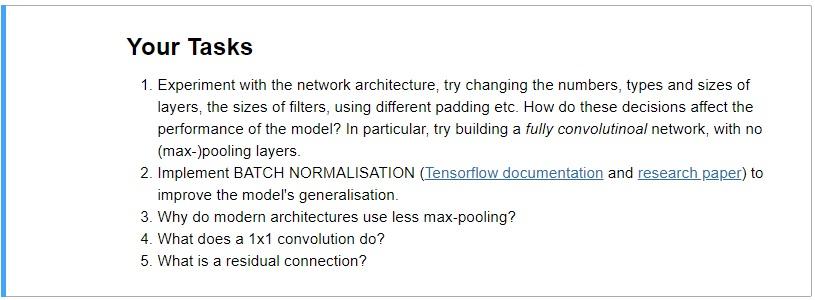
NB: Please only do Tasks 1-2
Our website has a team of professional writers who can help you write any of your homework. They will write your papers from scratch. We also have a team of editors just to make sure all papers are of HIGH QUALITY & PLAGIARISM FREE. To make an Order you only need to click Ask A Question and we will direct you to our Order Page at WriteEdu. Then fill Our Order Form with all your assignment instructions. Select your deadline and pay for your paper. You will get it few hours before your set deadline.
Fill in all the assignment paper details that are required in the order form with the standard information being the page count, deadline, academic level and type of paper. It is advisable to have this information at hand so that you can quickly fill in the necessary information needed in the form for the essay writer to be immediately assigned to your writing project. Make payment for the custom essay order to enable us to assign a suitable writer to your order. Payments are made through Paypal on a secured billing page. Finally, sit back and relax.
Do you need help with this question?
Get assignment help from WriteEdu.com Paper Writing Website and forget about your problems.
WriteEdu provides custom & cheap essay writing 100% original, plagiarism free essays, assignments & dissertations.
With an exceptional team of professional academic experts in a wide range of subjects, we can guarantee you an unrivaled quality of custom-written papers.
Chat with us today! We are always waiting to answer all your questions.